Tavoliere & Murgia · Eat
Altamura and its bread
A loaf the size of a cushion, a crust you can knock on, and a town that has been baking it since before anyone wrote the recipe down.
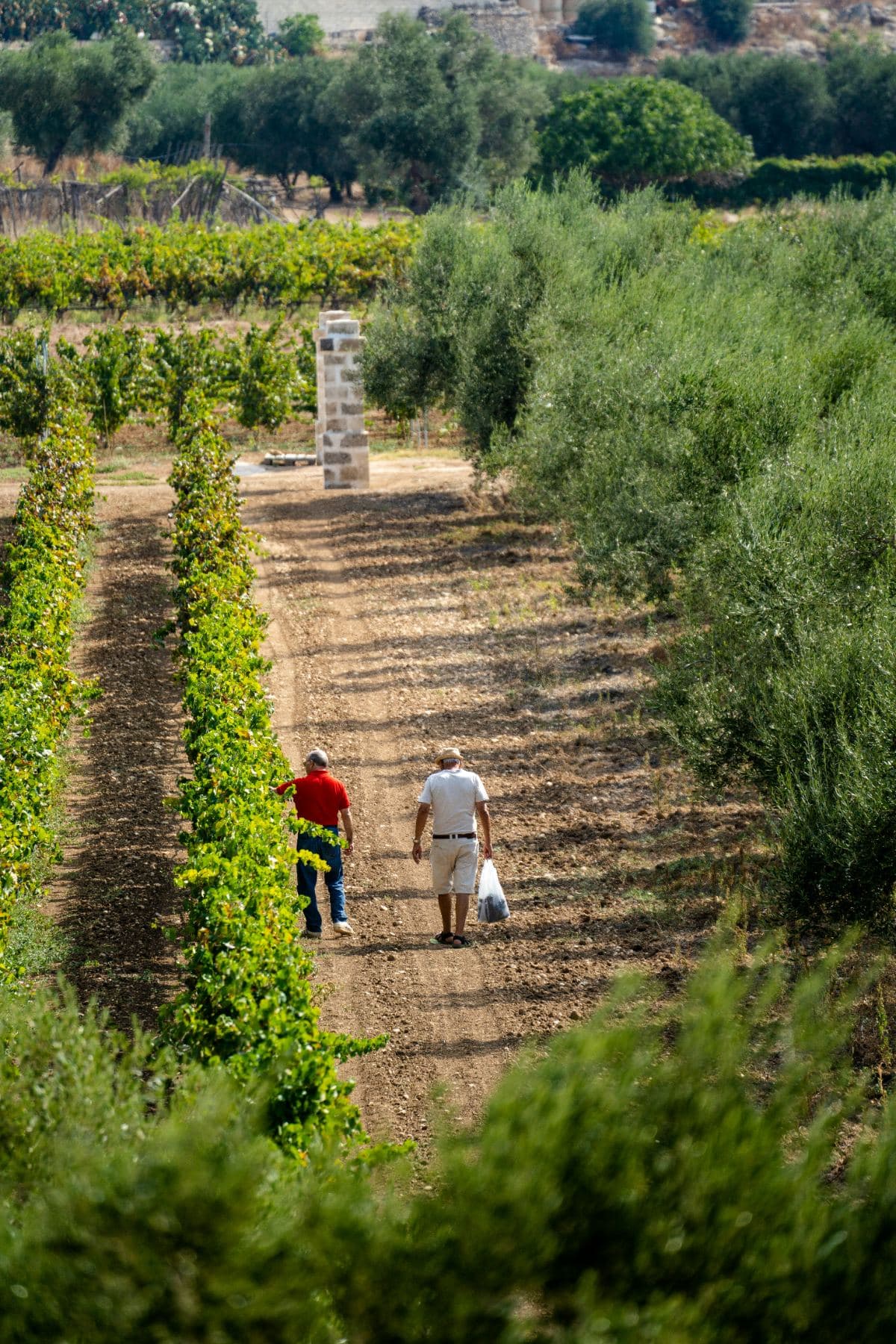
Durum wheat on the Murgia, which is where the loaf begins.
You smell Altamura before you see it. The old town is small, the ovens are many, and on a still morning the whole place smells of wood smoke and baking. Then you turn a corner and there is a loaf in a window the size of a cushion, dark gold, with a crust that looks as though it would ring if you knocked on it. It would.
Altamura is a handsome hill town on the edge of the Murgia plateau with a Frederick II cathedral, a Neanderthal in a cave and dinosaur footprints in a quarry, and it is famous for none of these things. It is famous for bread, and rightly.
Why the bread is protected
In 2003 the European Union gave Pane di Altamura a protected designation of origin, the first bread in Europe to get one. The rules that came with it are exacting. The flour must be semolina milled from durum wheat grown on the Murgia, from specific varieties. The leaven must be natural, a mother dough kept alive and fed. Salt, water, nothing else. The loaves must be baked in a wood-fired oven, traditionally fuelled with oak, and the crust must be at least three millimetres thick. There are two accepted shapes: a tall folded one, and a lower rounder one that is said to look like a priest’s hat.
The bread this produces is unlike a northern loaf. The crumb is yellow from the durum wheat, dense and slightly sweet, with an open irregular texture. The crust is thick and almost bitter. It was made for a reason: the shepherds and farmhands of the Murgia were away from home for a week at a time, and they needed bread that would last. This does. It is at its best on the second day and still good on the seventh.
The town likes to say that the poet Horace, passing this way on the road to Brindisi two thousand years ago, wrote that the bread here was the best he had eaten and worth carrying for the rest of the journey. Whether he meant Altamura precisely is a question for classicists. The town has taken the compliment personally ever since and does not intend to give it back.
How it is made
The dough is mixed in the evening and left to rise slowly overnight on the strength of the mother leaven alone, which gives the crumb its flavour and its keeping quality. In the morning it is shaped, folded, and baked in ovens that have been hot since before dawn. Some of the ovens are very old. One, off a lane near the cathedral, claims to have been baking since 1423, and stands in a stone room with a domed oven mouth and a fire that never quite goes out.
The most telling detail is the stamp. Until a few generations ago, most families made their own dough at home and carried it to the communal oven to be baked with everyone else’s. To tell the loaves apart, each family pressed a wooden stamp with its initials into the top before it went in. Some bakeries still stamp their bread, and if you look at the crust of a loaf in a window you may see letters baked into it. It is the signature of a town that has always baked together.
Buying it
Walk the lanes around the cathedral in the morning and follow the smell. The ovens are marked, and most have a small shopfront where the loaves are stacked on wooden shelves. Ask for one whole, not cut, and hold it: it should be heavy for its size, and the crust should sound hollow. A half-kilo loaf is a good size to carry; the larger ones are a commitment, but they last.
The same ovens sell focaccia, thick and soft with tomatoes pressed into it, and often taralli and biscuits. Buy focaccia for now and bread for later. Then look for cialledda, the Murgia’s bread salad: stale Altamura bread soaked briefly in water and tossed with tomatoes, cucumber, onion, oil and oregano. It is what the bread was invented for and it is a perfect lunch in the heat.
The claustri
Altamura’s old town is organised into something you will not see elsewhere in Puglia. Off the main street, dozens of small courtyards open through narrow passages, each one a tiny enclosed square with houses on all sides and a single way in. These are the claustri. They were built for defence, so that a family or a small community could shut the entrance and hold the courtyard, and they became the social unit of the town, with a well, a shared oven and a bench in each. There are said to be around eighty. Wander into any that is open. They are still lived in, still swept, and still, on a warm evening, full of people sitting out.
The cathedral
Frederick II founded the cathedral in 1232, one of a handful of churches he built directly, and it has been altered by everyone since. The rose window and the great carved portal on the facade came in the fourteenth century, and the portal is the thing to look at: a deep sequence of arches crowded with figures telling the story of the Gospels in stone, with a Last Supper over the door, guarded by a pair of lions who look as though they have been waiting a long time. Inside it is quieter. Outside, the square in front is where the town’s evening happens.
The Man of Altamura
In 1993 cavers exploring a cave system a few kilometres outside the town found a skeleton at the bottom of a shaft, fused into the rock by centuries of dripping calcite so that only the skull and some bones showed through the stone. It was a Neanderthal, and one of the most complete ever found, and it was somewhere between a hundred and two hundred thousand years old. It cannot be moved, and the cave is closed to protect it. The town’s museum tells the story with a reconstruction of the cave and of the man himself, and the film of the discovery is worth the ticket.
He is not the only thing under the Murgia. Five minutes out of town is the Pulo, a sinkhole in the plateau nearly half a kilometre across and a hundred metres deep, with caves in its walls that were lived in from the Neolithic on. And in 1999, in a disused quarry outside the town, workers found thousands of dinosaur footprints in a single bed of limestone, left by herds crossing a tidal flat when this was the edge of a shallow sea. Access to the quarry is limited and changes; ask at the museum.
Eating in Altamura
Beyond the bread, this is Murgia food. Fave e cicorie. Cardoncelli mushrooms. Lamb. Pecorino. Orecchiette, though the Bari kind, not the Altamura kind, would be a fighting distinction to make in either town. The trattorias in the old town are simple and good, and the rule holds: short menu, no photographs, full of locals.
Onward to Matera
The railway from Bari continues past Altamura to Matera, twenty-five minutes further on, across the regional border into Basilicata. If you have the day, take it. Matera’s cave city is one of the extraordinary places of Europe and it is right here. Altamura in the morning for the bread, Matera for the afternoon and the evening, and back to Bari on the last train with a loaf under your arm. That is a day.
Before you ask
Questions we get about Altamura
What is special about Altamura bread?
It was the first bread in Europe to be given protected designation of origin status, in 2003. It must be made from durum wheat semolina grown on the Murgia, with natural leaven, salt and water, and baked in a wood-fired oven. The result is a high, dark-crusted loaf with a dense yellow crumb that stays good for a week.
How long does Altamura bread keep?
A week easily, and often more. It was made for shepherds and farm workers who were away from home for days at a time, and the thick crust and dense crumb were designed to last. It is arguably better on the second day than the first.
Can you see the Man of Altamura?
Not the skeleton itself. It is fused into the rock of a cave outside the town and cannot be removed or visited. The town’s museum shows a full reconstruction, a film of the cave, and the story of the discovery, which is very well done.
Keep reading
Nearby, on the page
Tavoliere & Murgia · 6 min
Castel del Monte and the high Murgia
An octagonal castle that explains nothing, the sheep plateau around it, and the towns on its edges that feed you.
Read the guide
Valle d’Itria · 6 min
Choosing a masseria in the Valle d’Itria
Working farms first, pools second, and a long table every evening. How to tell the real thing from a hotel with olive trees.
Read the guide
Salento · 6 min
Lecce after the passeggiata
Baroque stone turns gold at seven. Here is where to be when it does.
Read the guide