Salento · Places
Lecce after the passeggiata
Baroque stone turns gold at seven. Here is where to be when it does.

Pietra leccese, an hour before it goes gold.
Lecce is built from a stone so soft it can be carved with a knife, and for three centuries that is more or less what happened to it. Pietra leccese comes out of the ground the colour of biscuit, cuts like cheese, and hardens slowly in the air. Every architect who worked here between the sixteenth century and the eighteenth took this as permission. The result is a city where every church front, balcony bracket and doorway seems to be in the middle of saying something.
The mistake is to look at it at noon. Under a high sun the stone is flat and pale, the carving is a blur, and the streets are empty because everyone sensible is indoors. Lecce is a city for the evening. Come out at six, when the shutters go up and the light goes down, and it becomes a different place.
Why evening is the right time for Lecce
Two things happen at once. The light comes in low from the west and rakes across every facade, so that carving which was invisible at midday suddenly has depth and shadow and the stone goes, in the space of an hour, from cream to honey to something close to gold. And the city comes out to walk.
The passeggiata in Lecce is a proper one, the Salento version of the evening stroll that every Italian town performs but few perform as well. It runs from Piazza Sant’Oronzo along Via Vittorio Emanuele towards the Duomo, and back down Via Trinchese where the shops are, and round again. Families, couples, teenagers in packs, old men in pressed shirts who have done this walk every evening for sixty years. It is not a spectacle put on for visitors. It is simply what the city does, and the right thing to do is join it at walking pace and let it carry you.
Start in Piazza Sant’Oronzo at seven
The main square is the odd one. It is not baroque at all, or only at the edges. Half of it is a hole in the ground: the Roman amphitheatre, built in the second century, buried for most of the city’s life and dug out again in the early 1900s, so that a third of its seating now sits open to the sky beside the bank and the bars. On summer evenings there are concerts down there. On ordinary evenings people sit on its rim and watch the square.
Above it stands the column that gives the square its name. It is Roman too, one of the pair that marked the end of the Appian Way at Brindisi, brought here in the seventeenth century and topped with a bronze of Sant’Oronzo, the city’s patron, blessing the traffic. Beside it, the little Sedile, the old town hall, with its open arches, is the prettiest small building in the city and almost nobody looks at it.
Have a drink at one of the bars on the square’s edge and let the passeggiata start without you. Then follow it up Via Vittorio Emanuele.
Piazza del Duomo at dusk
The cathedral square is unlike any other in Italy. It is closed on three sides, like a courtyard, and entered through a single gap framed by a screen of statues. You walk through the gap and the city noise stops. Inside are the cathedral, its bell tower, the bishop’s palace and the seminary, all of them pale stone, all of them arranged so that whichever way you turn a facade is looking back at you.
Most of this is the work of one man. Giuseppe Zimbalo rebuilt the cathedral in the 1660s, gave it two facades, one plain and one anything but, and then built the bell tower next to it, seventy metres of stone that is visible from the sea. The square was designed to be shut at night against bandits, which is why it has only one way in, and the effect of that single entrance is still to make you feel you have been let into something.
Go in at dusk, when the last light is on the top of the tower and the square below is already in shadow. Stand in the far corner, by the seminary, and look back at the way you came. The cathedral’s side facade, the ornate one, faces you, and for about twenty minutes it is lit from within.
Santa Croce by lamplight
The basilica of Santa Croce is the building that makes Lecce famous, and it should be seen after dark, when the floodlights do what the sun cannot and pick out every figure on it. The facade took a century and a half, from the 1540s to the 1690s, and passed through several architects, Zimbalo among them, each of whom added another layer. The lower half is relatively calm. The upper half is a riot: a great rose window, a balcony held up by a row of straining figures and animals, griffins, dragons, a crowd of saints and putti, garlands, fruit, and a good deal that nobody has managed to explain.
You are meant to be overwhelmed by it. That was the point. Stand across the street with your back against the wall of the old convent next door, which is now the provincial government and has its own, quieter facade by Zimbalo, and take your time. Then look at the people passing in front of it. Nobody local glances up. This is the strangest and best thing about Lecce: a city that treats one of the great facades of Europe as a wall on the way to dinner.
Where to eat in Lecce, and when
Lecce eats in stages. At six, from a bar counter, a rustico: a round of puff pastry filled with béchamel, tomato and mozzarella, eaten hot with a paper napkin and no ceremony. It is the city’s snack and it is better than it sounds. At seven, the drink in the square. Not before half past eight, and ideally later, dinner.
The dishes to look for are Salento’s, not Puglia’s in general. Ciceri e tria is chickpeas with ribbons of pasta, some of them boiled and some of them fried until they shatter. Sagne ’ncannulate are long twisted ribbons with tomato. There will be horse on the menu, in a slow tomato stew called pezzetti, and it is a tradition here rather than a novelty, so nobody will mind whether you order it or not. The wines are Negroamaro and Primitivo, both dark, and the local rosé is taken seriously.
Trattorias worth your evening are, as everywhere, the ones a lane or two off the main walk with a short menu and a full room of people who live here.
The morning after: pasticciotto and caffè leccese
Lecce’s breakfast is a pasticciotto, a small oval of shortcrust pastry filled with thick custard, served warm if you time it right. Every bar makes them. The right way to eat one is standing at the counter with a caffè leccese, which is espresso poured over ice with a little almond milk, and which will ruin all other iced coffee for you.
Then walk. The morning is for the things the evening did not need. Porta Napoli, the triumphal arch at the top of the old town, built for Charles V in 1548. The castle he built at the other end, which is now used for exhibitions. The cartapesta workshops, where papier-mâché saints are still made the way they were when the churches could not afford marble, and where you can buy something small and strange. And one house near the cathedral where a plumbing repair in the year 2000 turned into an excavation, and which is now a small museum of everything that was found under the floor: two thousand years of it, layer by layer, a whole city in cross-section beneath one family’s kitchen.
Then leave by the Porta Rudiae road, west, towards the Ionian. The sea is twenty minutes away, and you will be back by seven.
Before you ask
Questions we get about Lecce
What is Lecce famous for?
Its baroque architecture, carved from a local limestone so soft it can be worked with a knife. Also for pasticciotto, the custard-filled pastry eaten at breakfast, and for cartapesta, the papier-mâché craft that made the saints in half the churches of Salento.
Is one day enough for Lecce?
One evening and one morning is the right amount. The centre is compact and the pleasure is in the light and the walk, not in ticking off buildings. Use the middle of the day for the coast, which is twenty minutes away in either direction.
What should I eat in Lecce?
A rustico from a bar counter at six, then ciceri e tria or sagne ’ncannulate at a trattoria after nine, with a glass of Negroamaro. In the morning, a pasticciotto and a caffè leccese, which is espresso poured over ice with almond milk.
Keep reading
Nearby, on the page
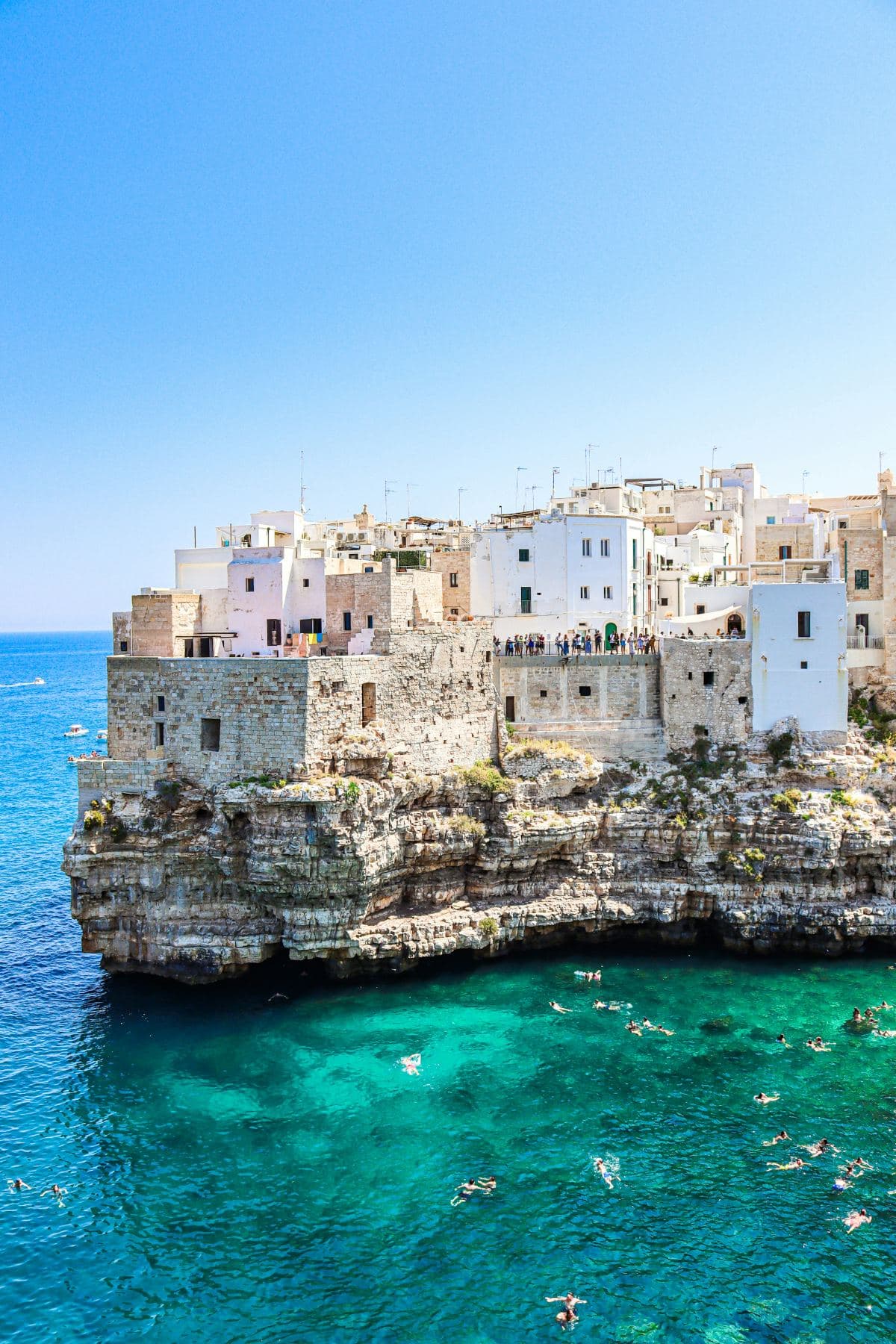
Salento · 6 min
Swimming the Adriatic ledges
Flat rock, clear water, no sand. The ledges locals keep quiet about.
Read the guide
Tavoliere & Murgia · 6 min
Altamura and its bread
A loaf the size of a cushion, a crust you can knock on, and a town that has been baking it since before anyone wrote the recipe down.
Read the guideTavoliere & Murgia · 6 min
Castel del Monte and the high Murgia
An octagonal castle that explains nothing, the sheep plateau around it, and the towns on its edges that feed you.
Read the guide