Salento · Swim
Swimming the Adriatic ledges
Flat rock, clear water, no sand. The ledges locals keep quiet about.
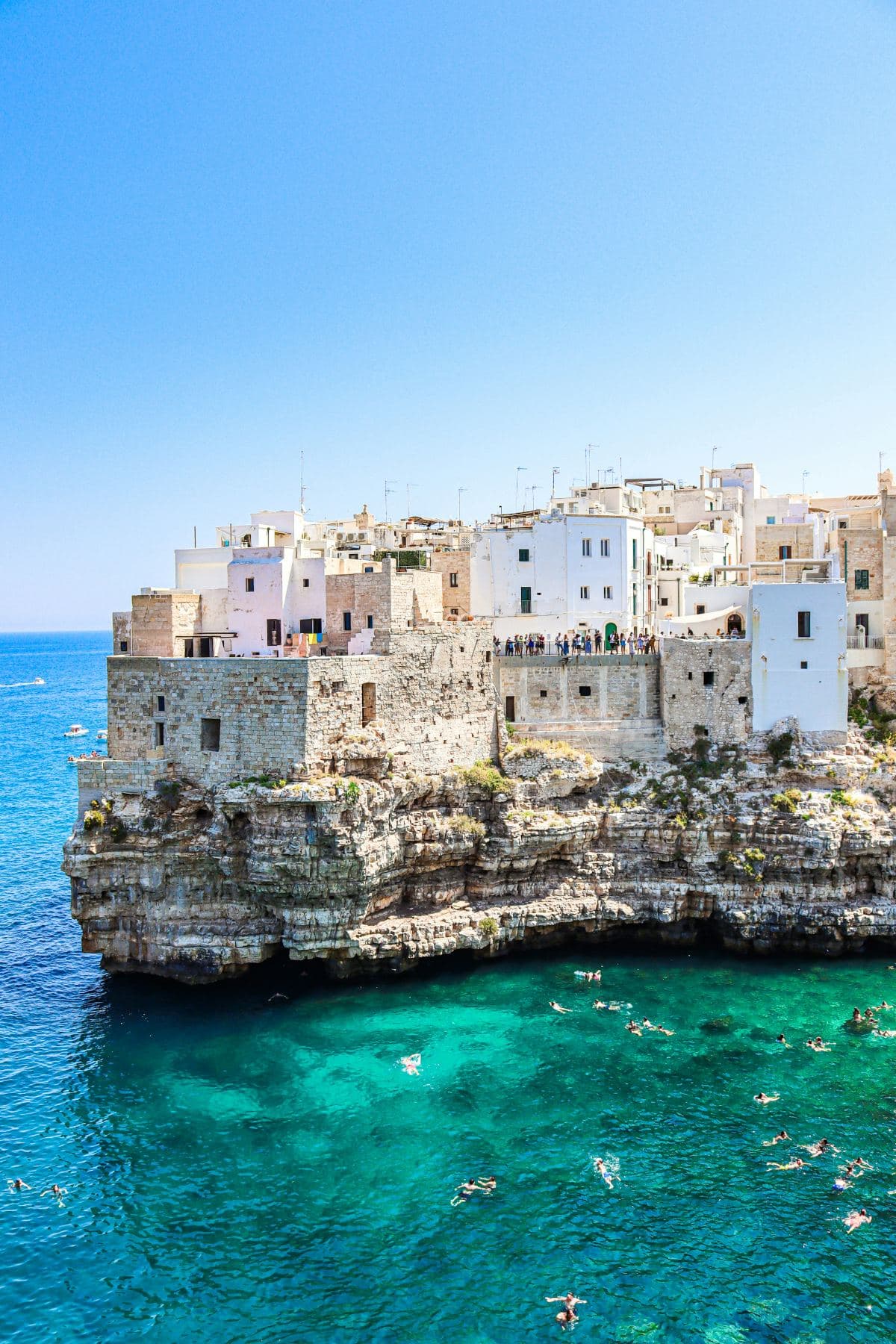
Limestone, sea, and nowhere to put an umbrella. Perfect.
Salento’s Adriatic coast does not do beaches in the usual sense. From Otranto south to the tip of the heel, the land ends in shelves of pale limestone, worn flat by the sea, that drop straight into water clear enough to count the stones on the bottom. There is no sand, no gradual entry and nowhere to plant an umbrella. Instead there are ledges: a towel on the warm rock, a ladder bolted to the edge, and a sea that is deep enough to dive into a metre from where you were sitting.
Locals have swum this way for generations and would prefer you did not notice. Every one of these places has a small colony of people who arrive at nine with a cool box, wedge a parasol into a crack in the rock, and stay until the light goes. They are welcoming, in the way of people who assume you will be quiet. Be quiet.
How Salento’s two coasts work
The heel of Italy has a sea on each side, and they behave differently. The Ionian coast, to the west, is sandy and shallow and faces the afternoon sun. The Adriatic coast, to the east, is rock and cliff and faces the dawn. Which one you swim from on any given day is decided by the wind, and everyone here checks the wind before they check anything else.
The scirocco blows from the south-east, warm and damp, and it pushes the sea onto the Adriatic side until the ledges are awash and the water is cloudy. On a scirocco day the whole of Salento drives west to the sand. The tramontana and the maestrale come from the north, drier and cooler, and they flatten the Adriatic to glass while roughing up the Ionian. Those are the days for the ledges. Learn this rule and you will never arrive at the wrong coast.
Roca and the Grotta della Poesia
Half an hour north of Otranto, the coast is low and pitted with sinkholes, and one of them has become famous. The Grotta della Poesia is a round pool of sea water in the rock, connected to the open sea by a cave, with sheer walls to leap from and a colour that looks retouched. It is very beautiful and, in July and August, very full. Access is now limited in summer and there is often a queue.
The trick is not to fight it. Around the pool lie the ruins of Roca Vecchia, a Messapian and then medieval settlement whose walls run out over the flat rock to the sea, and either side of the famous hole the coast is one long swimming ledge with nobody on it. Arrive at eight, look at the pool, and then walk two hundred metres and swim from the rock with the ruins behind you. In September, come whenever you like.
Otranto: the town between swims
Otranto is where the coast changes. North of it, sand; south of it, rock. The town itself sits on a small headland inside a great Aragonese castle, and it has two things you should not miss even on a day meant for the sea.
The first is the cathedral floor. In the 1160s a monk named Pantaleone laid a mosaic across the whole nave: a Tree of Life with Adam and Eve and Alexander the Great and King Arthur and a bestiary of creatures that nobody has fully decoded, all rendered in tiny stones with the freedom of somebody who had not been told the rules. It is one of the strangest and most alive medieval works in Italy and you can walk on it.
The second is in a side chapel: the bones of the eight hundred townspeople killed when the Ottomans took Otranto in 1480, arranged behind glass. It is a hard thing to look at and the town does not soften it. Then go outside, buy an ice cream, and swim from the town beach, which is sand, before the rock begins.
South of Otranto: the lighthouse and Porto Badisco
The coast road climbs out of Otranto and the land turns to scrub and stone. The first turning worth taking leads down to the lighthouse at Punta Palascìa, the easternmost point of Italy, where people gather on New Year’s morning to see the first sunrise in the country. On an ordinary day it is a white tower on a bare cape with the sea on three sides and, on a clear morning, the mountains of Albania across the water.
A few minutes further south, Porto Badisco is a narrow inlet with a small pebble cove at its head and rock ledges along both sides. Legend has it that Aeneas landed here on his way from Troy. What is certain is that the sea urchins are excellent, that the bar at the top serves them in season, and that the ledges on the southern side, past the last house, are the best swim between Otranto and Santa Cesarea.
On the way, if the light is right, stop at the old bauxite quarry inland of Otranto: a crater of rust-red earth with a green lake at the bottom, unlike anything else on the coast and free to look at.
Santa Cesarea Terme and Castro
Santa Cesarea is a spa town hung on the cliff, with sulphur springs in the caves below it and a skyline of Moorish villas built by nineteenth-century families who wanted to take the waters in style. The grandest has a great dome and looks as though it has been lifted from somewhere on the Bosphorus. Below the town, the rock platforms are cut with steps and fitted with ladders, and the swimming is in deep water off a ledge with the villas above you. This is the coast at its most civilised.
Castro is ten minutes further and comes in two parts. Castro Marina, at sea level, is a small harbour with a few restaurants and a stone quay to swim from. Castro Superiore, on the cliff above, is the old town with its castle and its views. From the harbour, boats run to the Grotta Zinzulusa, a sea cave with stalactites hanging from the roof like the rags that give it its name. Take the boat. The cave is genuinely worth it and the coast seen from the water is another thing again.
The Ciolo and the road to Leuca
The last stretch to the tip of the heel is the wildest. The coast road runs high above the sea past terraced hillsides and dry-stone walls, and at the Ciolo it crosses a deep inlet on a bridge. People jump from the bridge into the water below. Do not be one of them. Walk down the path instead to the small cove at the bottom, where the cliffs close in on either side and the water is the deepest blue on this coast, and swim out of the inlet into the open sea if it is flat.
Then go on to Santa Maria di Leuca, where the road ends. There is a lighthouse, a sanctuary called De Finibus Terrae, the end of the earth, and a point where the Adriatic and the Ionian are said to meet and where, on a day with a wind on one side and not the other, you can almost see the seam.
The etiquette of a ledge
The ledges stay good because of how people use them. Take everything home, including the peach stones. No speakers. Claim a modest patch and do not spread. Wear shoes on the rock, because the sea urchins are real and the limestone is sharp. Use the ladders. Swim out from the ledge and along the coast rather than across the mouth of a cave. And if somebody who has clearly been coming here for fifty years tells you the swell is getting up, get out.
Then dry off in the sun, on the warm rock, with the smell of the scrub behind you and nothing at all in front but sea. This is what the coast is for.
Before you ask
Questions we get about Otranto
Are there sandy beaches near Otranto?
Yes. The long beaches north of the town, Alimini and the Baia dei Turchi, are sand and shallow water. The rock ledges begin south of Otranto and run all the way to the tip of the heel.
Can you swim in the Grotta della Poesia?
In summer access is limited and the pool is crowded from mid-morning. Go at eight, admire it and swim off the flat rocks either side instead, or come back in September when it is nearly empty.
Is the Adriatic side or the Ionian side better for swimming in Salento?
They are different seas. The Adriatic side is rock, cliffs and deep clear water. The Ionian side is sand and shallows. Let the wind choose: scirocco means Ionian, tramontana means Adriatic.
Keep reading
Nearby, on the page

Salento · 6 min
Lecce after the passeggiata
Baroque stone turns gold at seven. Here is where to be when it does.
Read the guide
Tavoliere & Murgia · 6 min
Altamura and its bread
A loaf the size of a cushion, a crust you can knock on, and a town that has been baking it since before anyone wrote the recipe down.
Read the guideTavoliere & Murgia · 6 min
Castel del Monte and the high Murgia
An octagonal castle that explains nothing, the sheep plateau around it, and the towns on its edges that feed you.
Read the guide