Tavoliere & Murgia · Places
Castel del Monte and the high Murgia
An octagonal castle that explains nothing, the sheep plateau around it, and the towns on its edges that feed you.
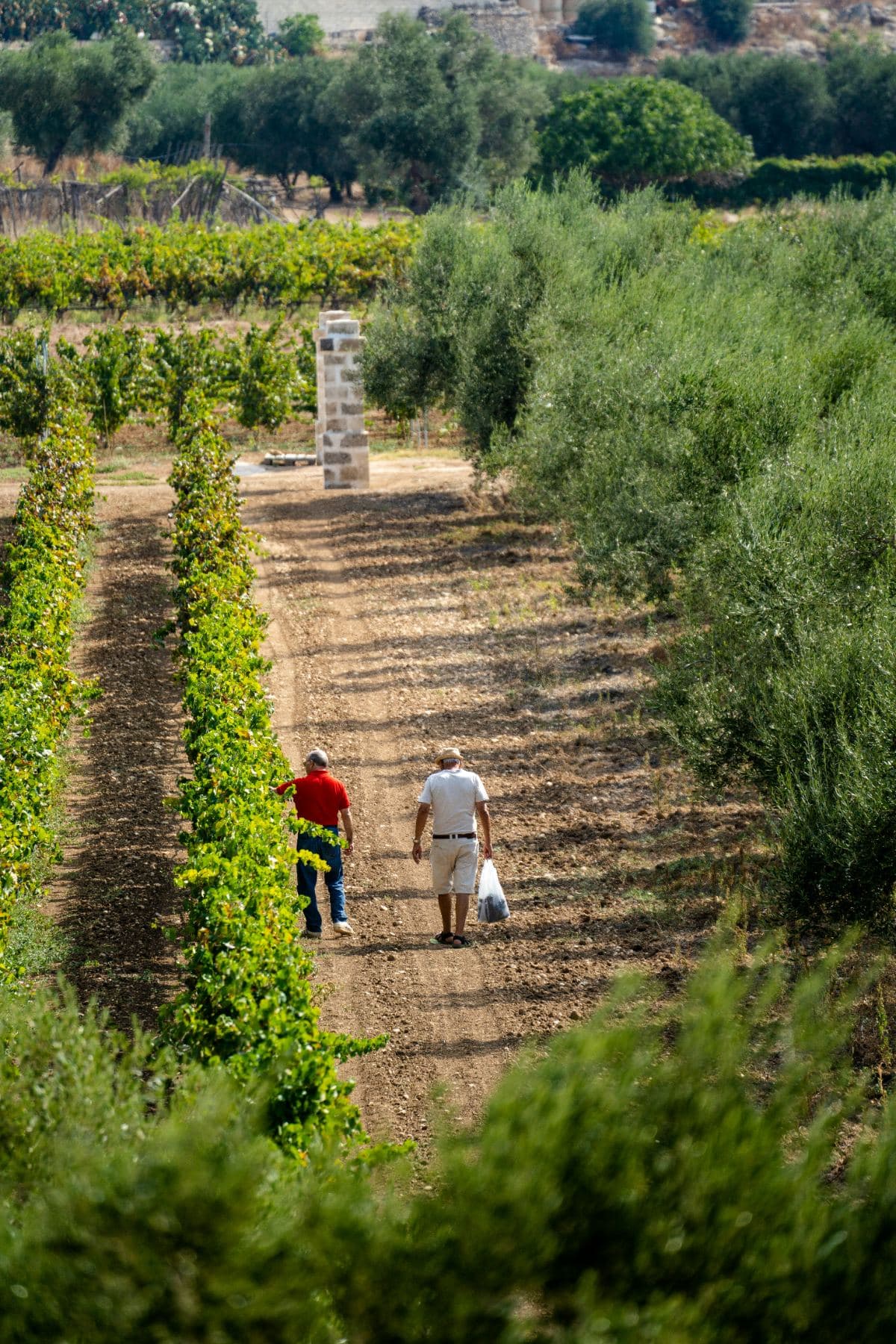
The plateau in late spring, before the wheat turns.
From a distance, and you see it from a great distance, Castel del Monte looks like a crown set down on a hill. It stands alone on a rise of the Murgia plateau with nothing around it but wheat and sky, and it is visible for twenty kilometres in every direction. Closer, it resolves into a pale octagon with a tower at each corner, and it becomes clear that whoever built it was not primarily interested in defending anything.
Frederick II, Holy Roman Emperor, King of Sicily, poet, falconer and the most interesting man of the thirteenth century, had it built around 1240. He died ten years later and left no explanation. Eight centuries on, it is a UNESCO site, it is on the back of the Italian one-cent coin, and it still explains nothing.
The castle that explains nothing
Everything about it is eight. Eight sides to the outer wall. Eight octagonal towers, one at each angle. Eight rooms on the ground floor and eight above, each a trapezoid, arranged around an octagonal courtyard. The proportions relate to each other in ways that mathematicians have spent careers on, and the whole thing is aligned so that light falls through particular windows on particular days.
What it does not have is as telling as what it does. There is no moat, no drawbridge, no arrow slits worth the name. There were no kitchens to speak of and no stables. It could not have withstood a siege and was never asked to. The best guesses are a hunting lodge, since Frederick wrote the definitive medieval book on falconry and the plateau was full of game; or a kind of retreat; or simply a building that said, in stone, that the emperor could put a perfect geometric object on a hill in the middle of nowhere because he felt like it.
The marble and mosaics that once lined the rooms were stripped over the centuries, some of them by the Bourbons for their palace at Caserta, and the castle spent a long period as a shepherds’ shelter and a prison. It has been restored to bare stone, which suits it. Stand in the courtyard and look up at the eight sides framing the sky, and you will understand as much as anyone does.
How to visit it well
Arrive early or late. In the middle of the day the light is flat, the coaches have arrived, and the hill has no shade. At opening time, or in the last hour of the afternoon, the stone goes warm and gold and the shadows of the towers stretch across the plateau.
Walk up from the car park rather than taking the shuttle. The approach is the experience: the castle grows as you climb and the plateau opens out behind you. Inside, go slowly through the ground floor rooms, then the upper ones, noticing the carved capitals and the window seats and the way each room opens into the next around the ring. There is no roof access. The visit is short, and it should be, because the building is best from outside, from the hill below, in the evening, with the wind in the wheat.
The plateau
The Alta Murgia is the high, dry limestone spine of inland Puglia, and it is a landscape most visitors to the region never see. There are almost no trees. There is wheat in the spring, stubble in the summer, and sheep all year, moving between dry-stone enclosures called jazzi that were built for the winter flocks that came down from the mountains along drove roads, the tratturi, some of which are still visible as broad green lanes. The park was created in 2004 to protect what is, in effect, a piece of steppe: rare orchids in April, lesser kestrels nesting in the towns, and a silence that is hard to find anywhere else in southern Italy.
Drive it slowly. Stop on a side road and walk out among the walls. In late spring the ground is red and purple with poppies and wild flowers and the air smells of thyme. In October it is bare and enormous and the light is unlike anywhere on the coast.
Andria, and the burrata question
The nearest town, on the plain below the castle, is Andria, a solid working place with a good old centre and a claim to have invented burrata. The story is that a cheesemaker here, early in the twentieth century, wrapped leftover shreds of mozzarella and cream in a pouch of stretched curd to keep them fresh, and that the pouch turned out to be better than what it was made to preserve. The claim is contested, as all such claims are. What is not contested is that Andria’s burrata is superb, and that you should eat one here, at room temperature, with bread and nothing else.
The wine appellation around the castle carries its name. Nero di Troia is the grape to look for: dark, structured, a little tannic, made for the lamb and the mushrooms of the plateau.
Ruvo and the vases
East of the castle, Ruvo di Puglia is a small town with two things worth an hour. The cathedral is one of the finest Romanesque buildings in the region, with a rose window and a facade that repays a slow look. And a palazzo on a side street holds a family collection of Greek and Apulian vases, assembled in the nineteenth century from the tombs around the town and never dispersed. The great piece is a huge red-figure krater showing the death of the bronze giant Talos, and the rest of the rooms are full of the painted ware that was made and buried here when this was part of the Greek world. It is one of the strangest and most rewarding small museums in Puglia.
Next door, Bitonto has another Romanesque cathedral and some of the best olive oil in the region, if you have the afternoon.
Gravina and the ravine
South-west, at the far edge of the plateau, Gravina in Puglia is a town split in two by a gorge. The old town sits on one side, honey-coloured and steep, and a stone aqueduct bridge crosses the ravine to the other, where cave churches and dwellings are cut into the rock. The bridge appeared at the start of a recent James Bond film, in which the hero jumped off it, and the town has been quietly pleased about this ever since. Walk across it instead. The views down into the gorge and back at the town are the best on the Murgia, and the cave churches on the far side, with their faded frescoes, are open at irregular hours and worth the gamble.
Twenty minutes further on is Altamura, which is a guide of its own and the reason the bread on your table is what it is.
Eating on the Murgia
The plateau feeds the towns around it. Look for cardoncelli, the meaty mushroom of the Murgia, grilled or in pasta in autumn. Lampascioni, small wild bulbs like bitter onions, preserved in oil. Fave e cicorie, the broad-bean purée with wild chicory that is the region’s peasant dish and one of its best. Lamb, cooked slowly. Pecorino from the flocks that graze the jazzi. And bread from Altamura, on every table, which you will find you cannot eat enough of.
Then drive back past the castle at dusk, when it is closed and lit and standing alone on its hill, and do not try to explain it to anyone.
Before you ask
Questions we get about Castel del Monte
Why is Castel del Monte octagonal?
Nobody knows for certain. It has eight sides, eight towers, and eight rooms on each of its two floors, built around an octagonal courtyard, and the geometry is too exact to be accidental. Theories range from a hunting lodge to an observatory to a statement of imperial power. The honest answer is that Frederick II did not explain, and the building does not either.
How long does it take to visit Castel del Monte?
An hour inside is enough, plus the walk up and down. The rooms are bare, so the visit is about the building itself. Combine it with a morning on the plateau or an afternoon in one of the towns.
What is the Alta Murgia?
The high limestone plateau of inland Puglia between Bari and Basilicata, a national park since 2004. It is a landscape of wheat, sheep, dry-stone walls and very few trees, and it is the emptiest country in the region.
Keep reading
Nearby, on the page
Tavoliere & Murgia · 6 min
Altamura and its bread
A loaf the size of a cushion, a crust you can knock on, and a town that has been baking it since before anyone wrote the recipe down.
Read the guide
Valle d’Itria · 6 min
Choosing a masseria in the Valle d’Itria
Working farms first, pools second, and a long table every evening. How to tell the real thing from a hotel with olive trees.
Read the guide
Salento · 6 min
Lecce after the passeggiata
Baroque stone turns gold at seven. Here is where to be when it does.
Read the guide