Bari & the coast · Eat
Orecchiette on Arco Basso
Watch, buy, and know when to stop asking questions and simply eat.

Semolina, water, a knife and a thumb. Nothing else.
There is one lane in old Bari where the women make orecchiette on trestle tables outside their front doors, and everyone in the world now knows about it. That does not make it less real, only more complicated. The pasta is still made the way it was made before anybody watched, by people who learned it from their mothers and are teaching it to their daughters. What has changed is the audience. This guide is about being a good one.
Where the lane is
Bari Vecchia is the old town, a dense knot of alleys on the peninsula between the two harbours, walled off from the nineteenth-century grid of the new city by a wide street and a change of century. Walk north from the station through the grid, cross the road, and you are in it. The castle is on the left, a great Norman and Swabian block with a moat. The lane runs off the square in front of it. It is called Via dell’Arco Basso, the street of the low arch, because that is what it passes under at the far end, and it is perhaps a hundred metres long.
By nine in the morning the doors are open, the tables are out, and the work has started.
How the pasta is made
Orecchiette are made from two things: semolina flour milled fine from durum wheat, and water. No egg. The dough is kneaded hard, rolled into a rope the thickness of a finger, and cut into small pieces with a blunt knife. Then the movement that takes years to learn: the knife drags each piece across the board so that it curls, and the thumb flips it inside out to make a small rough cup. An ear. Orecchiette means little ears. A practised hand does this faster than you can follow, and the finished pasta is laid on mesh screens to dry in the air of the lane.
The roughness is the point. The dragged surface catches sauce. Machine-made orecchiette are smooth and slippery and wrong, and once you have eaten the real thing you will notice the difference every time.
The same women make cavatelli, strascinati and other shapes from the same dough. They also, if you ask, sell the dried orecchiette in bags to take away, and this is the thing to buy.
How to buy without being a nuisance
The lane has become a stop on every tour of Bari, and for a while that caused trouble. A few years ago the authorities took a close interest in how the pasta was being sold and whether the paperwork was in order, and for a short time the doors closed in protest. They reopened. The women are still there. But the episode left a wariness, and the visitor who behaves well is doing something for the lane, not just for themselves.
The rules are simple. Say good morning. Ask, with a gesture, before you take a photograph, and accept it if the answer is no. Watch for a minute, not ten. Then buy a bag. Pay what is asked, in cash, without comment. If you have questions about how it is done, the moment to ask is after you have paid, and one or two is enough. Then move along and let the next person have the table.
Do not ask for a demonstration. Do not touch the drying pasta. Do not bargain. And do not, whatever the internet has told you, try to test whether the pasta was made this morning. It was.
What else the old town does at that hour
Bari Vecchia in the morning is one of the great living old towns of the Mediterranean, and the orecchiette are only part of it. A few minutes from the lane is the basilica of San Nicola, built after 1087 to house the bones of Saint Nicholas, which sailors from Bari had stolen from a church in Turkey and brought home in triumph. The saint is the same one who became Father Christmas, and the crypt where he lies is a place of pilgrimage for Orthodox as well as Catholic Christians. On any morning there will be Russian and Greek pilgrims in the crypt and Bari grandmothers in the nave, and the building is one of the purest Romanesque churches in Italy.
Between the basilica and the cathedral of San Sabino, the bakeries sell focaccia barese: a soft, oily, dimpled bread with cherry tomatoes and olives pressed into the top, eaten in the street from a square of paper. From doorways, especially towards evening, women fry sgagliozze, squares of polenta, and sell them in cones. And down at the old port, on the quay the locals call N’derr a la lanz, the fishermen sell what they have caught straight from the boat and the custom is to eat some of it there, raw: sea urchins by the dozen, and octopus that has been beaten against the rocks until it is tender enough to eat with a squeeze of lemon and a plastic cup of cold beer at ten in the morning.
What to do with the bag
If you are staying somewhere with a kitchen, cook it tonight. Boil the cime di rapa first, in salted water, then the orecchiette in the same water. In a wide pan, warm olive oil with a couple of crushed garlic cloves, an anchovy fillet or two and a small dried chilli, until the anchovy dissolves. Add the greens and the drained pasta, toss, and eat immediately. It takes fifteen minutes and it is the best thing you will make on holiday.
If you are not, the dried bag travels. Wrap it in a shirt. It will survive a suitcase and it will be, back home on a wet Tuesday, the taste of this lane.
Bari beyond the lane
Do not leave the city as soon as you have the pasta. Bari is a real port city rather than a museum, and it rewards a day. Walk the seafront, which curves for kilometres along the Adriatic with the old town at one end. Sit in the grid of the new town, which is handsome and lively and completely un-touristed. Look at the opera house, rebuilt after a fire. And then, if the weather is good, take the train down the coast to Polignano a Mare and Monopoli for a swim, which is a guide of its own and the best afternoon Bari has to offer.
Before you ask
Questions we get about Bari
Where is the orecchiette street in Bari?
Via dell’Arco Basso, in Bari Vecchia, a few metres from the Swabian castle. It is a short lane and the women work outside their front doors along it and in the arches at the end.
Can you take orecchiette home?
Yes. Ask for the dried ones, which keep for weeks and survive a suitcase. Fresh ones need to be cooked within a couple of days and should be kept cool.
What else should I eat in Bari Vecchia?
Focaccia barese, with cherry tomatoes and olives pressed into the top, from one of the bakeries near the basilica. Sgagliozze, squares of fried polenta sold from doorways. And raw octopus or sea urchins at the old port, where the fishermen sell straight from the boat.
Keep reading
Nearby, on the page
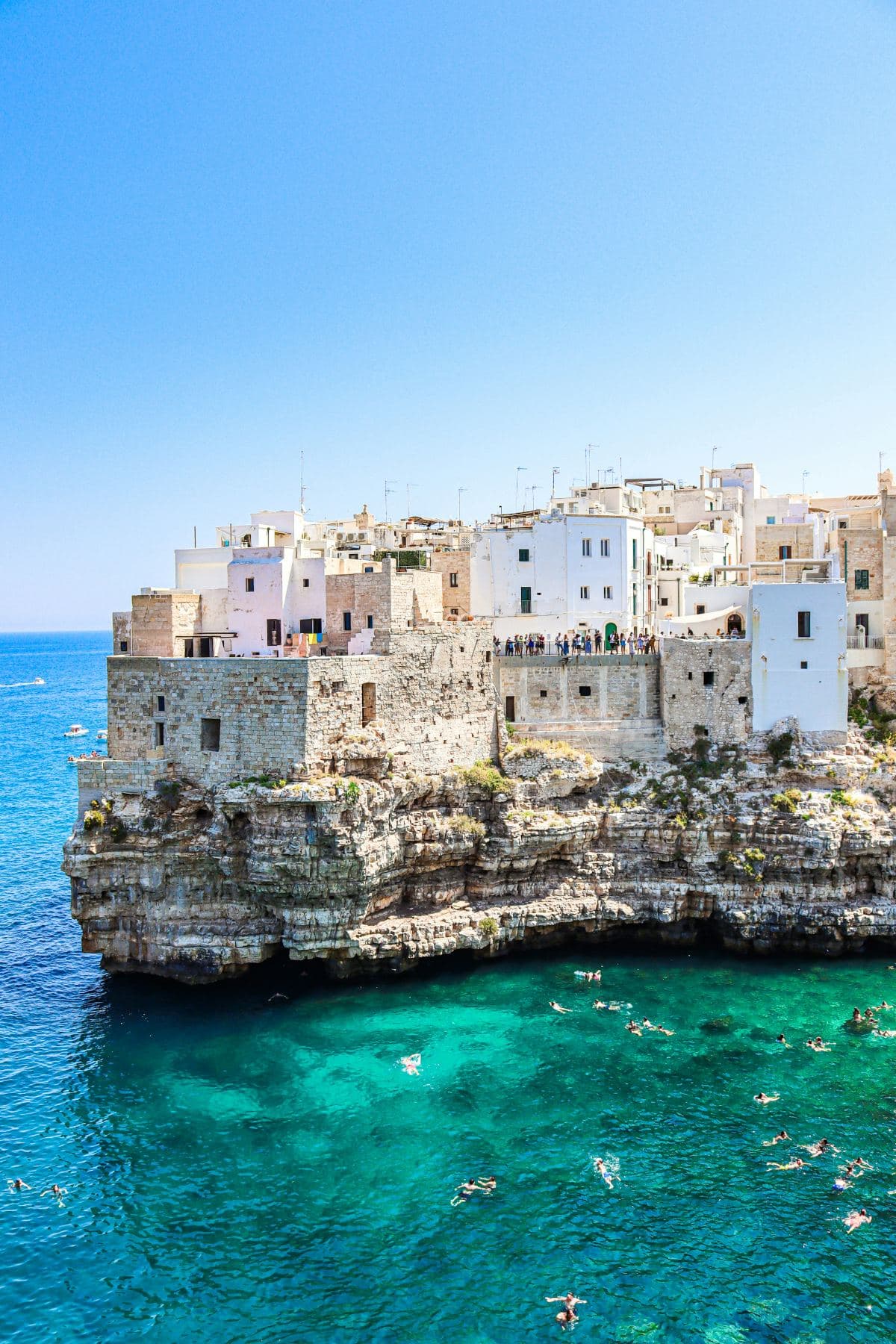
Bari & the coast · 6 min
Polignano to Monopoli by train
Two towns, seven minutes apart, and no need for a car. Swim under the cliffs, then finish in a working port.
Read the guide
Tavoliere & Murgia · 6 min
Altamura and its bread
A loaf the size of a cushion, a crust you can knock on, and a town that has been baking it since before anyone wrote the recipe down.
Read the guideTavoliere & Murgia · 6 min
Castel del Monte and the high Murgia
An octagonal castle that explains nothing, the sheep plateau around it, and the towns on its edges that feed you.
Read the guide