Bari & the coast · Ways through
Polignano to Monopoli by train
Two towns, seven minutes apart, and no need for a car. Swim under the cliffs, then finish in a working port.
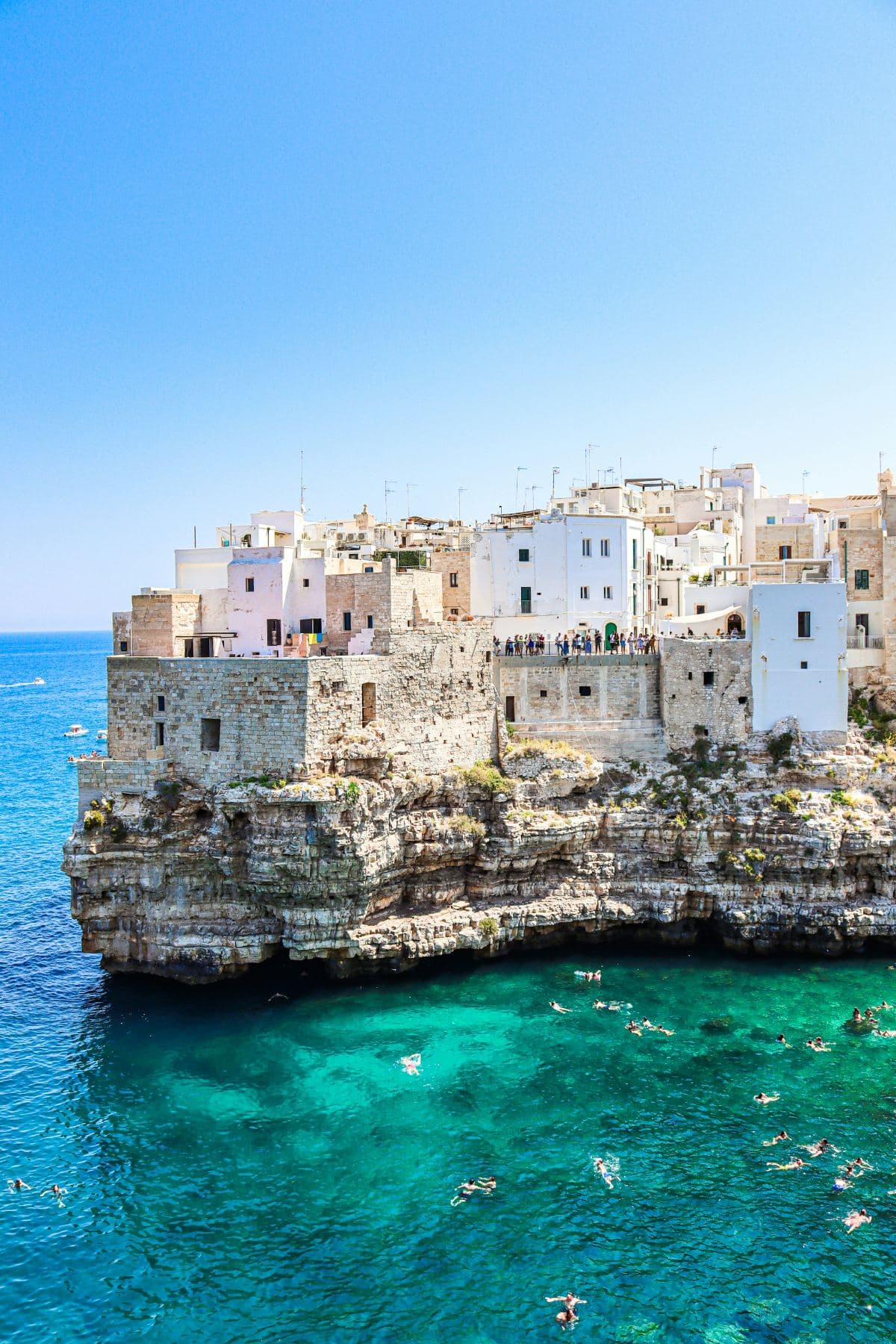
Polignano at eight in the morning, which is the only time to see it like this.
The railway from Bari runs south along the coast with the sea on the left, and about half an hour out it passes two towns seven minutes apart that between them make the best car-free day in Puglia. Polignano a Mare is the one on the postcards, an old town balanced on limestone cliffs above a cove. Monopoli is the one the postcards miss, a working port with a walled old town and a beach beneath it. Do both, in that order, and leave the car in Bari.
Bari to Polignano: thirty minutes
Any regional train towards Lecce will do. Sit on the left, seaward side. The line runs through olive groves with the Adriatic appearing and disappearing beyond them, and the towns on the coast flash past as white walls and church towers. Polignano’s station is on the inland side of the town; walk downhill for ten minutes through the newer streets and the old town appears ahead of you, on its rock, with the sea behind.
Be there by nine. This matters more in Polignano than anywhere else in this region.
Polignano before ten
The old town is entered through a single stone gateway, the Arco Marchesale, and is small enough to cross in five minutes. What makes it extraordinary is what it stands on. The houses are built to the very edge of the cliffs, and at three or four points the lanes open onto terraces that hang over the water with nothing between you and the sea forty metres below. In the morning, with the light coming in off the Adriatic and the town still asleep, these terraces are among the loveliest places on the coast. By noon in August there is a queue for the railing.
The cove is below the town on the northern side. Lama Monachile is a narrow inlet where a dry riverbed meets the sea, with a small pebble beach at its head, cliffs on both sides, and a high stone road bridge built by the Bourbons spanning the gap above it. It is the view every photograph of Polignano shows and it does not disappoint. Walk down, put your shoes on for the pebbles, and swim out to where the water turns from green to deep blue. Then get out before the beach fills, which it will.
Every summer the terraces above the cove host a round of the cliff-diving world series, and if you happen to be here on the day you will not need to be told. Otherwise, do not jump off anything.
The town’s most famous son is Domenico Modugno, who wrote and sang the song the world knows as Volare, and there is a bronze of him on the seafront with his arms flung wide. People pose in front of it copying the pose. It is hard not to.
There is also a restaurant in a sea cave under the cliff, whose photographs you have already seen. Leave it to the photographs.
Where to eat in Polignano
Polignano’s morning speciality is a coffee: espresso with a little cream, a splash of amaretto and a twist of lemon peel, served in a small glass, which the town regards as its own and which is very good at eleven on a hot day. Have one at a bar on the main square. Then a panzerotto, the fried half-moon of dough filled with tomato and mozzarella that is Bari’s street food, or a plate of raw fish if you have found somewhere quiet enough to sit down for one.
Then walk back up to the station. The train to Monopoli takes seven minutes and you will spend more time waiting for it than on it.
Monopoli: a working port
Monopoli’s station is a fifteen-minute walk from the sea, through a pleasant ordinary town, and the change of mood is immediate. This is a port that still works. The old harbour is full of small fishing boats painted blue and red, the fish market is on the quay, and the old town behind it is a real neighbourhood of lanes, washing lines and small churches rather than a stage set.
The castle on the harbour wall was built by Charles V in the sixteenth century to keep out the Turks and now holds exhibitions. The cathedral, up in the old town, is dedicated to the Madonna della Madia, whose icon is said to have arrived by sea in 1117 on a raft of timber beams, at exactly the moment the builders needed beams for the roof. The town celebrates this twice a year, in December and August, by carrying the icon back into the harbour by boat at dawn. On any other morning the church is quiet, baroque inside and heavy with gold, and the square in front of it is a good place to sit.
The afternoon swim
Below the old walls, on the seaward side, is Cala Porta Vecchia: a small beach of sand and shingle enclosed by the old fortifications, with clear water and the old town rising behind it. It is a town beach, used by the town, and in the afternoon it is full of children, grandmothers and people who have walked down from their houses in flip-flops. Join them. There is nowhere better to swim on this coast that does not require a car, and the light on the walls in the late afternoon is the equal of anything in Polignano.
If it is full, the rocks along the seafront south of the old town are flat enough to lie on and the water is the same.
Monopoli in the evening
The evening belongs to the port. The passeggiata loops around the harbour and through Piazza Garibaldi, the old town’s main square, where the bars put tables out under the trees. Have a drink there and watch the boats come in. Then eat fish, because this is a fishing port and there is no reason to eat anything else: raw to start, then something grilled, at one of the places along the harbour or in the lanes behind it.
The last trains back to Bari run late, and the walk to the station in the dark through the quiet new town is a pleasant end. Or stay. Monopoli has small hotels in the old town and is a better base for this coast than Polignano, than Bari, than almost anywhere. Wake up here, swim before breakfast, and take the train the other way, south, to Ostuni and the Valle d’Itria.
If you have a car after all
South of Monopoli the coast continues past long beaches at Capitolo to the Roman ruins of Egnazia, standing among ancient olive trees a few metres from the sea, and then to Savelletri and the masserie of the Fasano coast. All of it is worth a day. But the point of this one was to leave the car behind and let the train choose the pace, and it will have chosen well.
Before you ask
Questions we get about Polignano a Mare
Is Polignano a Mare worth visiting?
Yes, for a morning, and early. The old town on its cliffs is one of the most beautiful sights on the Adriatic. By late morning in summer it is also one of the most crowded, so arrive by nine, walk the terraces, swim, and be on the train by lunchtime.
Can you swim in Polignano a Mare?
Yes. The cove at Lama Monachile, between the cliffs below the old town, is the famous place: pebbles, clear water and a Bourbon-era bridge overhead. There are also rock platforms north of the old town. Go early, because the cove is small.
Polignano or Monopoli, which is better?
Polignano for the look, Monopoli for the day. Polignano is a set piece and best seen briefly and early. Monopoli is a working port with a proper old town, a sand beach under the walls, and a better evening. Stay in Monopoli.
Keep reading
Nearby, on the page

Bari & the coast · 5 min
Orecchiette on Arco Basso
Watch, buy, and know when to stop asking questions and simply eat.
Read the guide
Tavoliere & Murgia · 6 min
Altamura and its bread
A loaf the size of a cushion, a crust you can knock on, and a town that has been baking it since before anyone wrote the recipe down.
Read the guideTavoliere & Murgia · 6 min
Castel del Monte and the high Murgia
An octagonal castle that explains nothing, the sheep plateau around it, and the towns on its edges that feed you.
Read the guide