Valle d’Itria · Places
The slow road to Ostuni
White walls, hot stone, and where to eat when the churches close at noon.
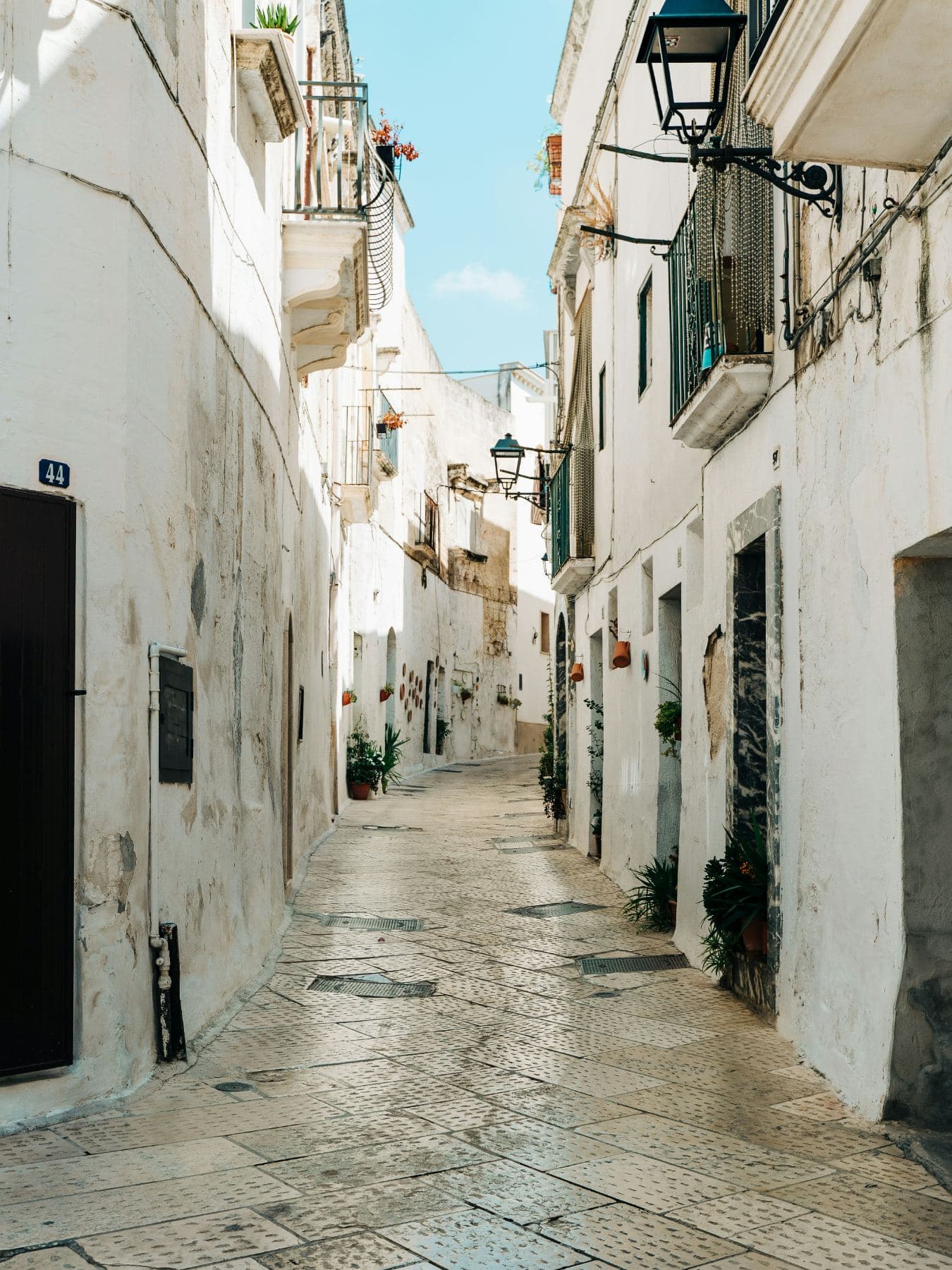
The Terra, mid-morning, before the shutters come down.
Arrive from the sea side if you can. The road up from the coast crosses the olive plain first, and for ten minutes the town is a white smudge on the ridge ahead, appearing and disappearing behind trees that were old when the Normans came through. Then the road climbs, the trees stop, and Ostuni is suddenly all there is: three hills of lime and shadow, stacked so tightly they read as a single building.
Most people arrive from the other direction, along the main road from Fasano or Brindisi, and see the car parks first. Both routes end in the same place. But the plain is the point. Ostuni is not a hill town that happens to have a view. It is a town that exists because of what surrounds it, and the plain of ancient olives between the walls and the Adriatic is the best possible introduction to why anyone built here at all.
Arriving in Ostuni: park low, walk high
The old town, which people here call the Terra, was never designed for cars and does not pretend otherwise. Park below the walls and give yourself the climb. From the ring road that circles the base of the hill, lanes go up in every direction. Pick one that looks cooler than the others and follow it.
Almost immediately the whitewash begins. It is not decoration. The story the town tells is that lime went on during the plague years because it was the only disinfectant anyone had, and that it stayed because it kept the houses cool and because, by then, nobody could imagine the place any other colour. Whatever the truth of the origin, the maintenance is real. Every spring someone is up a ladder with a brush, and if you look closely at the corner of a doorway you can see the layers, dozens deep, softening every edge into something closer to a sand dune than a wall.
The lanes fold back on themselves. Steps become streets become somebody’s front terrace. Arches cross overhead, some of them structural, holding facing houses apart or together, and some of them simply there because an arch seemed like a good idea. You will get lost. This is fine. The town is small enough that any uphill lane ends at the cathedral and any downhill lane ends at the ring road, so there is no real way to stay lost for long.
Ostuni cathedral and the top of the town
The Cattedrale di Santa Maria Assunta sits on the highest of the three hills, and its facade is the one thing in Ostuni that is not white. Honey-coloured stone, a late Gothic rose window with an improbable number of spokes, and a curved roofline that would not look out of place in Venice, which is where the builders of the late fifteenth century seem to have been looking.
Beside it, the Arco Scoppa joins the bishop’s palace to the old seminary across the lane. It is a bridge with a loggia on top, and photographers stand beneath it all morning waiting for the light to reach the cathedral steps. Stand somewhere else. The best view of the facade is from a doorway on the far side of the little square, in the shade, where you can look at it for as long as you like without anyone asking you to move.
Just below the cathedral, the town’s small museum occupies a former convent. Its centrepiece is a burial from the Palaeolithic: a young woman, found in a cave a few kilometres from here, laid to rest with shells and ochre a very long time before anybody thought of lime. It takes twenty minutes and it changes how the rest of the town looks. People have been choosing this ridge for longer than there have been towns to choose.
Where to eat in Ostuni, and when
By half past twelve the churches lock their doors, the shops pull their shutters down, and the piazza belongs to the cats and the light. This is the moment first-time visitors get wrong. They keep walking, keep looking, and end up eating at one o’clock at the only place still touting for custom on the main square, which is never the place you want.
The better plan is to have decided where lunch is before the bells. The rules are simple. Avoid anything with a laminated menu or photographs of the food. Look for a room with a short handwritten list, a television that is switched off, and at least one table of people who are clearly not on holiday. In Ostuni these places tend to be a lane or two back from the main routes, behind the cathedral or on the lower slopes of the old town, and they do not need to advertise because their customers come back.
What to order is easier. Orecchiette with cime di rapa, the bitter greens cooked down with garlic and anchovy, is the dish of the province and every kitchen has a version. Fave e cicorie, a purée of dried broad beans with wild chicory on top, sounds austere and is not. In summer there will be frise, the twice-baked bread rings softened with water and piled with tomato, and a plate of burrata that will make you reconsider every other burrata you have eaten. Ask for the house wine. It will come from the plain you drove across and it will be fine.
Then do what the town does. Go back to wherever you are staying, close the shutters, and lie down. The afternoon in Ostuni is not for sightseeing. It is for being horizontal.
White walls that were hard and flat at noon go soft and faintly gold, then pink, then blue.
Ostuni in the evening
Come back up at six. This is when Ostuni becomes the place people remember, and it is almost a different town from the one you walked through in the morning.
The light changes first. White walls that were hard and flat at noon go soft and faintly gold, then pink, then blue, and the shadows in the lanes turn from black to something you can see into. The town fills slowly, from the bottom up. The passeggiata here is not the parade it is in Lecce. It is more of a general drift: families, dogs and teenagers on the same slow loop between the ring road and the piazza, everyone pretending not to look at everyone else.
Piazza della Libertà is where the drift ends. The column in the middle carries Sant’Oronzo, the patron saint, who is credited with sparing the town from plague and is repaid every August with three days of lights, a procession on horseback and a very great deal of noise. On an ordinary evening the square is quieter than that, but only just. Take a table at the edge, order something cold, and watch the town go by for an hour. It is the best entertainment in Puglia and it costs the price of a drink.
Then eat late, and eat higher up, in the Terra, where the tables are set out on steps and the walls give back the day’s heat until well after ten.
The olive plain and the coast below Ostuni
Save one morning for the olives. Between Ostuni and the coast lies a plain of trees so old that the region has classified them as monuments, their trunks twisted into shapes that look carved rather than grown. Some are claimed to be more than a thousand years old, and standing next to one it is hard to argue. A few of the masserie down here still press their own oil and will show you round if you ask nicely and buy a bottle, which you will want to anyway.
The coast beyond is not the reason to come to Ostuni, but it is close enough to matter. The town’s own stretch of shore runs from low rocky coves to long sandy beaches, and a little further down the coast towards Brindisi the Torre Guaceto reserve keeps a piece of the Adriatic as it was before anybody built a lido: dunes, reed beds, clear water and a Saracen watchtower keeping an eye on nothing in particular. Swim there early, before the heat and the day visitors, then drive back up through the olives to a town that is just opening its shutters.
Day trips from Ostuni: Cisternino, Ceglie and Carovigno
Ostuni is the anchor for the whole northern end of the Valle d’Itria, and none of the neighbours is more than half an hour away. Cisternino is smaller, whiter, and known for its butchers’ grills, where you choose the meat at the counter and eat it at a table outside. Ceglie Messapica is the food town that food people talk about, and it is far less visited than it deserves. Carovigno is the quiet one. Martina Franca and Locorotondo lie further along the valley and are guides of their own.
Do not try to see all of them. Pick one, go for the afternoon, and come back to Ostuni for the evening. The town looks better every time you return to it, which is the surest sign of a place worth staying in.
Before you ask
Questions we get about Ostuni
Is Ostuni worth visiting?
Yes, and for longer than a day trip. The old town is small, but it changes completely between morning and evening, and the olive plain and coast below it are half the point.
How many days do you need in Ostuni?
Two nights. Spend the first on the town itself, walking early and again after six. Spend the second morning in the olive groves or swimming at Torre Guaceto, and the afternoon in one of the neighbouring towns.
Can you visit Ostuni without a car?
The town itself, yes. Ostuni station is on the Bari to Lecce line and a bus or taxi covers the last few kilometres uphill. For the plain, the coast and the neighbouring towns you will want a car.
When is the best time to visit Ostuni?
April to June and September to October. July is hot and full, August is hotter and fuller, and late August brings the feast of Sant’Oronzo, which is wonderful and very loud.
Keep reading
Nearby, on the page

Valle d’Itria · 6 min
Choosing a masseria in the Valle d’Itria
Working farms first, pools second, and a long table every evening. How to tell the real thing from a hotel with olive trees.
Read the guide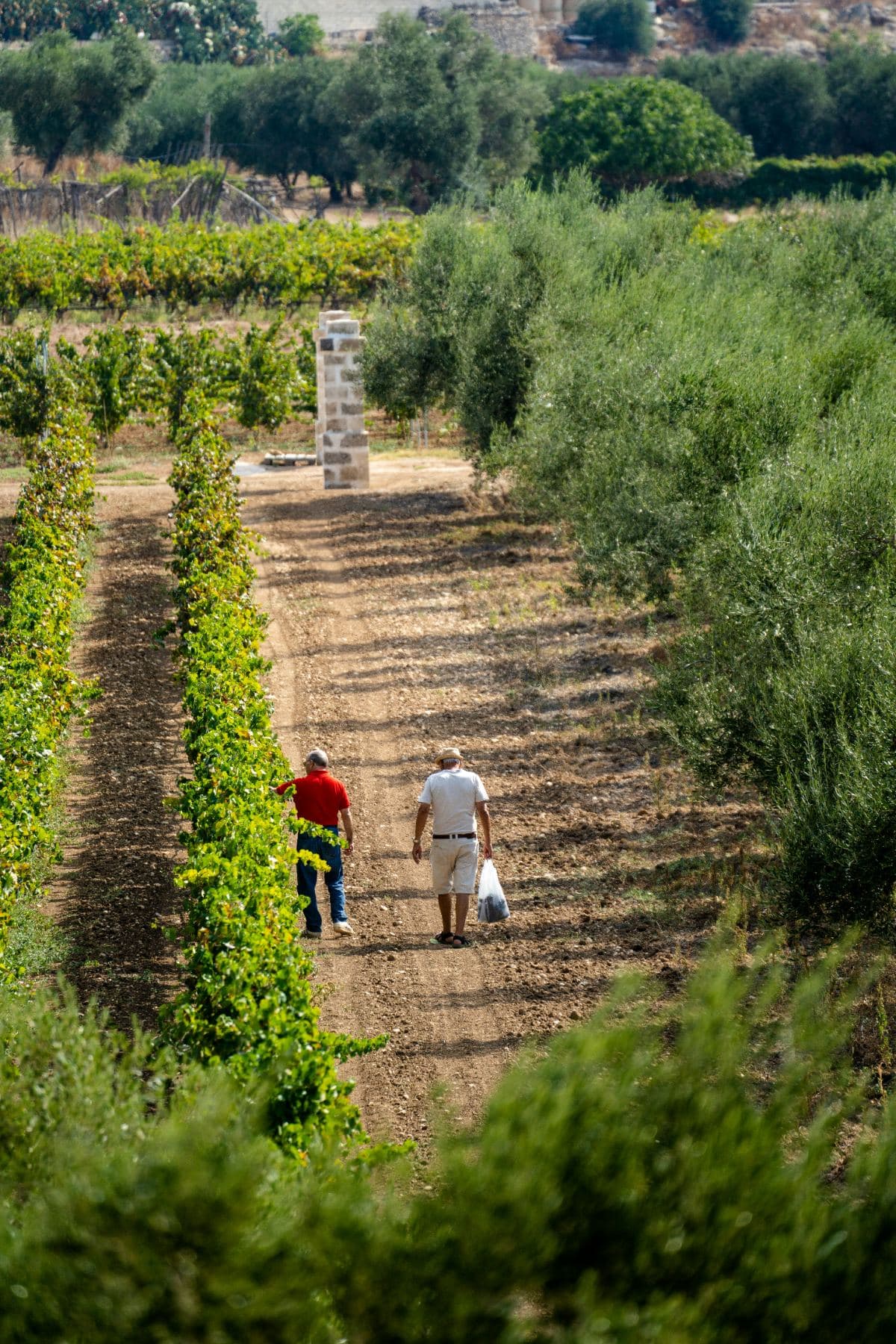
Tavoliere & Murgia · 6 min
Altamura and its bread
A loaf the size of a cushion, a crust you can knock on, and a town that has been baking it since before anyone wrote the recipe down.
Read the guideTavoliere & Murgia · 6 min
Castel del Monte and the high Murgia
An octagonal castle that explains nothing, the sheep plateau around it, and the towns on its edges that feed you.
Read the guide